
AI Assistant for Incident Management: A Better Starting Point for Your CAPA Plan
Meet our AI Assistant for Incident Management. It supports stronger corrective and preventive action (CAPA) planning by suggesting relevant follow-up actions based on incident context and past learnings, all directly inside your existing workflow.
Incident follow-up quality shouldn’t depend on who happens to be handling the case that day. Yet in reality, it often does. Time pressure, workload, or varying experience levels can lead to inconsistent action plans.
The TenForce AI Assistant provides a better starting point for corrective and preventive actions. It helps teams respond more thoroughly without automating decisions, creating actions without confirmation, or replacing investigators.
The quick read
The TenForce AI Assistant reviews the context of an incident and suggests relevant corrective and preventive actions based on past learnings. You choose which suggestions to use and refine them before launching the action plan. Nothing happens automatically, so your team stays in control while building more thorough and consistent CAPA plans.
Better prevention, without added admin
Built for high-risk environments such as manufacturing, food & beverage, and pharmaceuticals, this assistant strengthens follow-up without slowing response.
It helps you:
- Create actions that address likely causes and recurring patterns
- Reuse past learning instead of starting from scratch
- Apply consistent rigor across incidents and sites
- Spend less time asking “what should we do next?”
The goal isn’t speed alone (although it does reduce the time spent defining actions); it’s more thorough incident follow-up.
Prevention becomes less dependent on individual experience, and repeat incidents become less likely.
How it works inside your workflow
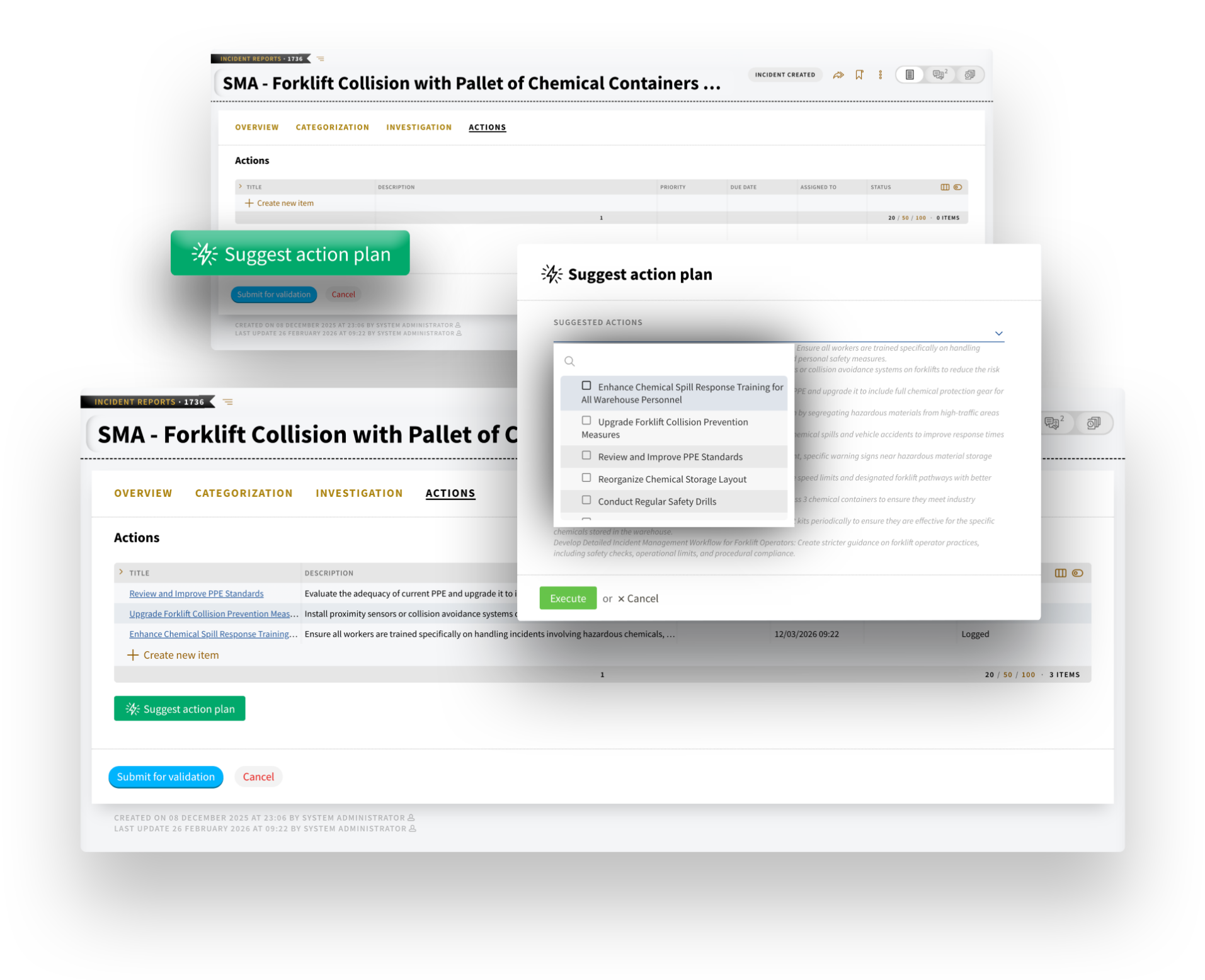
When you create or update an incident report, you can trigger the AI Assistant with one click.
It reviews
- The incident overview and categorization
- Investigation findings
- Immediate actions already taken
- Existing actions already defined
Based on this context (and relevant historical patterns), it suggests additional corrective and preventive actions in a simple dropdown list.
You decide what applies. The selected actions are then created and linked to the incident, ready for you to refine before the action plan is launched. Ownership, deadlines, prioritization, and details remain fully in your control.
Nothing is created automatically; there is no hidden logic, and sensitive injury documentation is not accessed. The workflow stays the same, and the responsibility stays with your team. But the quality of your CAPA plans improves.
Over time, action plans become more consistent. Learning travels across teams and sites. Incident management shifts from reactive reporting to structured prevention.
If you’d like to explore how it fits into your current workflow, or how it could support a new implementation, get in touch with our team.