Everything You Didn’t Know About Environmental Compliance in Heavy Industry
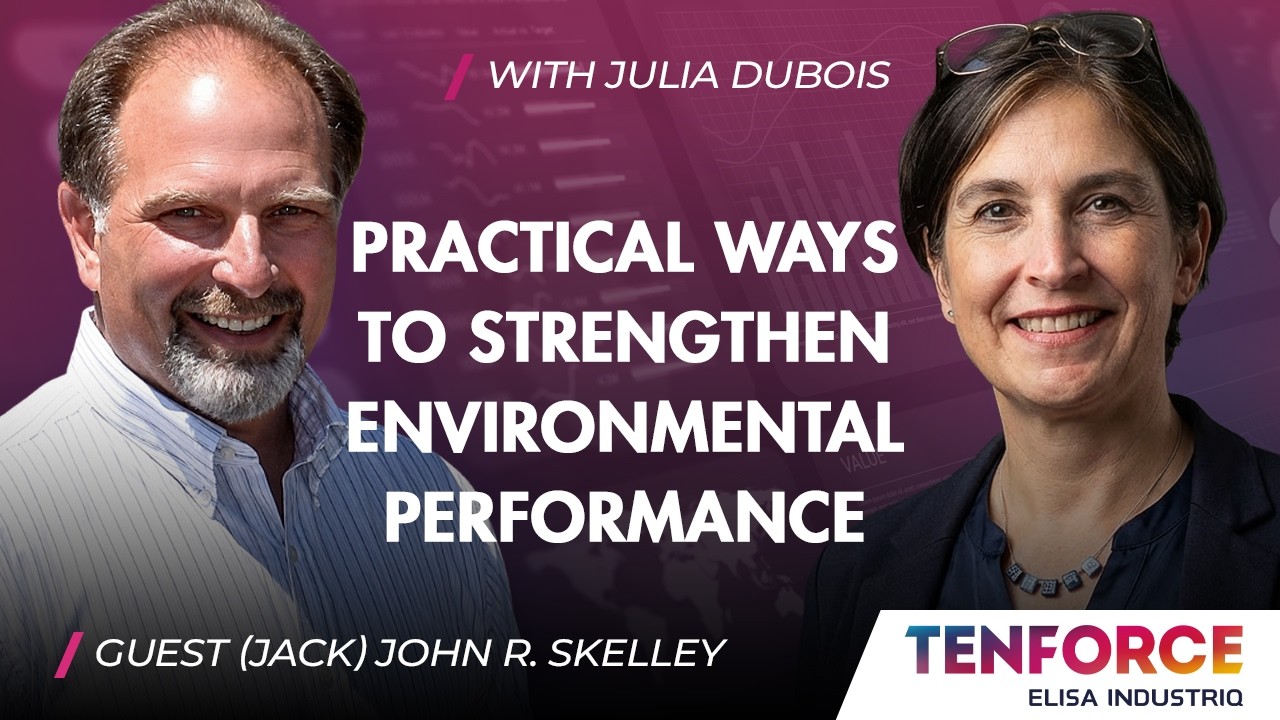
After 40 years in environmental work (including more than 30 in the electric arc furnace steel industry) Jack Skelley is preparing to retire. In the latest episode of The Pragmatic Safety Podcast, he joins TenForce COO Julia Dubois for a refreshingly honest conversation about the realities of environmental compliance in heavy industry.
Watch or listen to the full episode >
Environmental compliance is simpler than you think
If you were to ask Jack Skelley how he defines environmental compliance, he’d tell you that “it’s about 95% accounting.” It’s a surprisingly simple response, but Jack’s being truthful that compliance in heavy industry is mostly about organization and attention to detail.
The absolute hardest part of the job is the legal framework around it. Unlike criminal law, where you’re innocent until proven guilty, environmental law works the other way.
“You’re assumed guilty and you have to prove your innocence,” Jack explained. “That’s why on permits, there’s so many rules. You have to show that you are not harming the environment.”
The steel industry’s specific burden is substantial, given that they must comply with legislation covering almost every area of environmental protection, from air emissions and water use to waste management, and compliance is trickier to achieve than you might think.
Environmental programs need accountability
Having worked across facilities in more than a dozen states, Jack has seen why environmental programs that look strong on paper can fall short in practice. In his experience, the problem almost always comes down to discipline and accountability.
In staying compliant, supportive leadership is vital. As Jack puts it, “If you don’t have the support of your leadership, there’s no program that’ll work.” But beyond that, Jack has found that keeping “personalities” out of compliance keeps everything running smoothly. And that’s where technology comes in. It keeps everyone accountable with irrefutable hard data. For example, TenForce helps industrial teams do exactly that, with audit and inspection tools and incident management software that create objective records.
How technology is changing environmental compliance
Jack has watched environmental compliance evolve from clipboards and Lotus 1-2-3 spreadsheets to intelligent databases and automated monitoring systems, and his take on where technology fits into compliance matches that experience.
“The more automated you can make your routine, the easier it is then for you to be a manager,” he said.
Machines and computers handle routine tasks well, but they shouldn’t handle the non-routine anomalies and outliers that make any job difficult.
The practical implication is that the best environmental compliance programs use technology to free up human attention for the work that requires it. As Jack put it, the goal is to “be a manager, not just a technician.”
He also flagged the recent development that regulators are already using AI to review permits and submittals thoroughly.
“AI’s watching now,” he said. “If that’s the way they’re treating our submittals, they’ll be asking us for more data. So on our side, we need to be using the same kind of tools.”
What AI can (and can’t) do
Jack’s take on AI in environmental compliance is one of the most pragmatic we’ve heard on the show. First, he noted that he definitely sees value in its ability to handle large volumes of data and automate the repetitive analysis that used to eat up entire days.
“I couldn’t do trend analysis before. It was terrible. Because I’d have to get everybody’s spreadsheet, collate it together, set the analytics up myself.”
But he draws a clear line and acknowledges what AI plainly can’t do. “What I don’t see in environmental intelligence is thinking.” AI takes what exists and recombines it. For the fine details of environmental work, human expertise remains essential.
His advice to the next generation is founded on that knowledge. “Whatever you do, start with reality, a measurement of some sort.” In a field full of misinformation and increasingly complex data, staying focused on what’s definitively measurable and verifiable is the key to a good environmental compliance program.
What’s Next?
Jack is optimistic about where environmental compliance in heavy industry is headed, but realistic about the challenges. For one thing, regulations have tightened to the point where, in some cases, they’re making it difficult to build new industrial facilities at all. Problems might start to compound, too, now that environmental veterans like Jack are starting to retire.
The answer to the latter problem, in his view, comes from taking advantage of electronic systems. “If the organization of how you do this is set up electronically, then the brains are in the computer.” When the knowledge is in the system, turnover becomes manageable and continuity becomes possible.
That’s the future Jack is working toward before he signs off. He’ll be leaving the people behind him with the tools they need to be successful.
What EHS leaders should learn
Environmental compliance in heavy industry is only getting more complex, so weaving compliance into every system is crucial to success.
At TenForce, we work with industrial teams across chemical, oil and gas, and manufacturing to help them manage environmental and safety processes in one connected system. The shift from manual tracking to intelligent platforms that Jack describes is what we’re dedicated to supporting, whether it’s compliance tracking or audit management.
The Pragmatic Safety Podcast exists to bring conversations like this one into the open. Every episode is a candid conversation with a hands-on leader who has spent decades working through the real problems.
Subscribe so you don’t miss our next episode, and visit tenforce.com to explore how we help industrial teams build more connected operations.
Let’s make safety pragmatic. Starting now.
Watch or listen to the full episode now:
Spotify | Apple Podcasts | YouTube