
How to Build Safety Programs That Stick
Evan Jennings got his first education in safety aboard U.S. Navy aircraft carriers, where he spent ten years in naval nuclear power. Since then, he’s spent fifteen years developing safety programs in manufacturing as the Director of EHS at KPS Global. In the latest episode of The Pragmatic Safety Podcast, TenForce COO Julia Dubois sat down with Evan to talk about what it takes to make safety something people believe in.
Watch or listen to the full episode now: Spotify | Apple Podcasts | YouTube
The quick read
Safety programs start with understanding people, not introducing yet more rules. In this episode of The Pragmatic Safety Podcast, KPS Global’s Evan Jennings shares why awareness comes before accountability, how looking beyond worker behavior reveals the real causes of incidents, and why listening and following through are essential to building trust. Plus, where AI can help without replacing human judgment.
Taking safety seriously
Evan can point to the exact incident that pushed him toward a career in safety. While serving on the Navy’s reactor training team, he helped run live drills on the ship’s reactor systems. Before each drill, the team lined up valves and breakers and stationed people at critical points to make sure nothing was manipulated by mistake.
One of those people was a new trainee assigned to stand by a valve and keep anyone from opening it. What that trainee didn’t know was that the trainers had set the system up wrong, leaving a valve open upstream that shouldn’t have been. When the drill started, the tube pressurized, popped off, and sprayed him with scalding water. He suffered third-degree burns over 70% of his body.
The team was supposed to recheck the lineup before the drill, but it didn’t. “It helped me realize how important safety is, how important awareness is,” Evan said. That lesson has shaped everything he’s done since.
Awareness, alignment, and accountability
One of the toughest balancing acts in safety is giving workers the autonomy to think for themselves without losing control of the process. Evan’s answer involves a framework that his team calls “the three A’s of safety.”
It starts with awareness and making sure every worker knows what’s expected of them and why. Next, there’s alignment, where workers understand how the standard affects safety and buy into it. Only once those two are in place can you move on to accountability, where workers commit to the standard and leadership holds everyone to it.
The “why” is where it all comes together, because it explains how leaders can grow relationships with their workers, and as Evan put it, “relationship is the currency of influence.” Safety is moving away from compliance and control and toward commitment and care, and leaders need that relational currency to get people to do the right thing when it counts.
Understanding the behavior
Many behavior-based safety programs audit everything and chase trends in the data. Evan’s team takes a more conversational approach through what it calls interactive observations. The goal is to look past the behavior and the outcome and find the factors driving them, whether that’s a flawed process, fatigue, frustration, or complacency.
Evan’s team asks what pulled the worker’s attention away in the first place, because asking someone to simply pay more attention is asking for a behavior nobody can control. Fatigue, rushing, and frustration, on the other hand, are factors leaders can address.
Earlier in Evan’s career, a tank overflowed overnight and dumped about 500 gallons of antifreeze. At first, it looked like the second-shift operator simply forgot to close a valve, but the production manager had coached him to leave it open so the system could vent overnight. What looked like an operator error was really a knowledge gap and a process failure. Digging past the first explanation to find the real root cause is something that TenForce’s incident management software has been designed to help teams with.
Listening grows trust
The best proof of Evan’s approach comes from the floor. During one observation, his team saw a new employee climbing a press instead of using a step stool. He’d never been told that the stools existed, and the coworker who trained him always climbed the press too. The accountability landed on the trainer, who knew the right way and still taught the wrong one, and Evan’s team asked whether moving the stools or buying more would help.
In another case, operators kept dragging long material with a standard forklift instead of the specialized one bought for the job, because the new lift handled poorly outside. Instead of just enforcing the rule, Evan asked them for a solution. They proposed driving it through the building with a flagger, and when Evan followed up a few days later, they said it worked better than anything they’d tried.
“Follow through, follow up,” Evan said. “That’s how leaders build trust.”
Where technology fits
Evan sees value in what technology is doing for safety. Camera-based ergonomic assessments can analyze body mechanics and flag overexertion points, bringing objectivity to one of the most subjective assessments in the field. AI can also relieve administrative burden by generating audits, digitizing handwritten records, and sorting through large sets of data to find trends.
But he’s careful about how far he trusts it. AI works well with strict boundaries and factual inputs, but asking it to predict what will happen next can go off the rails. TenForce’s AI capabilities are centered around that same principle.
Safety programs that stick
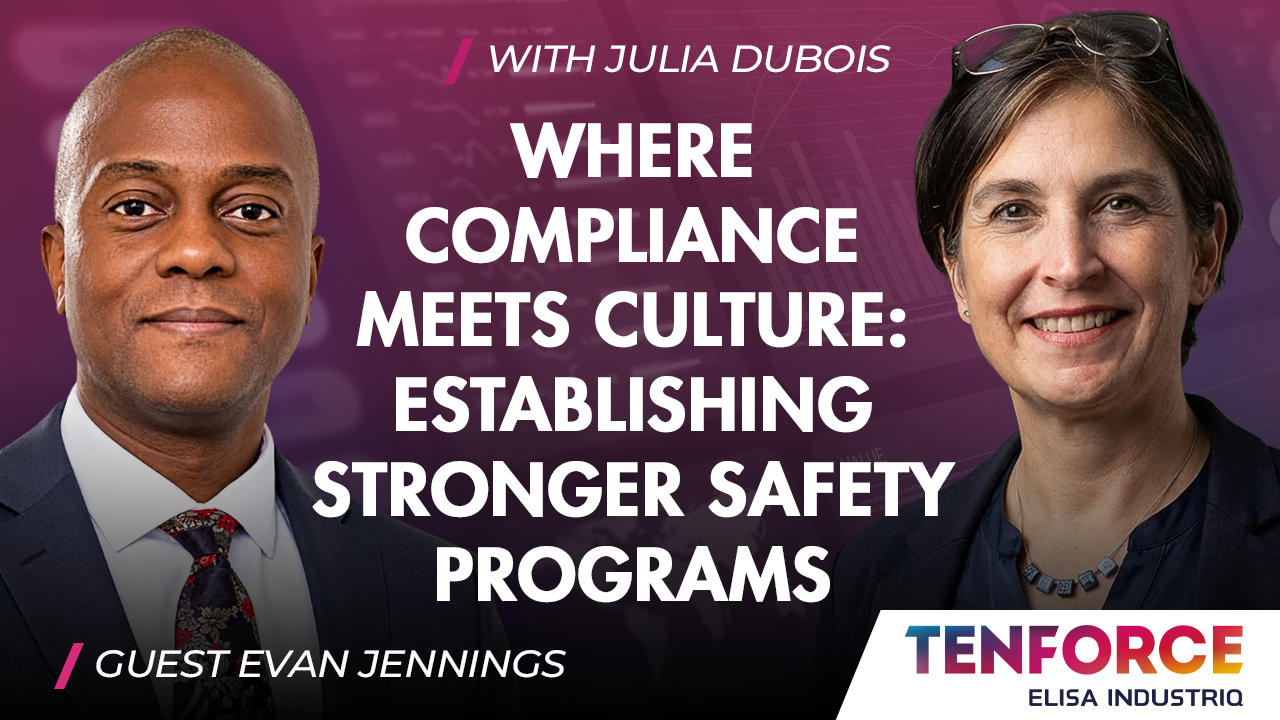
Evan’s career proves that a safety culture revolves around the people who carry it out, and that’s why the best programs are written with workers in mind.
At TenForce, we work with industrial teams across chemical, oil and gas, and manufacturing to help them manage safety processes in one connected system. Whether it’s audits and inspections or incident investigations, our tools are designed to give leaders the data they need to follow through on what they promise.
The Pragmatic Safety Podcast exists to bring conversations like this one into the open. Every episode is a candid conversation with a hands-on leader who has spent decades working through the real problems in safety, operations, and environmental performance.
Subscribe so you don’t miss our next episode. Let’s make safety pragmatic, starting now.
Watch or listen to the full episode now: Spotify | Apple Podcasts | YouTube